

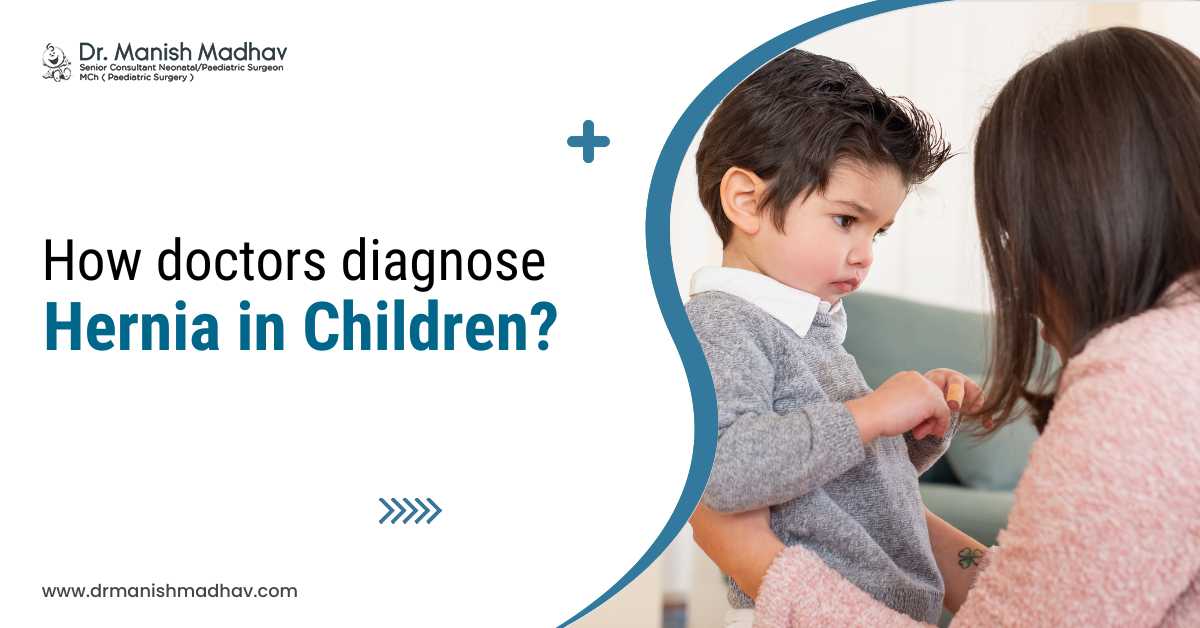
Children, particularly newborns and toddlers, are more likely to get hernias. You may find the condition frightening, but good results are typically achieved with early diagnosis and treatment. Here, you can identify the symptoms early and seek medical assistance if you are aware of how doctors diagnose hernias in children.
This blog talks about the causes, symptoms, diagnostic techniques, and medical procedures to detect hernias in kids. For effective child surgery in Siliguri, reach out to the top pediatric surgeon in the city.
Hernia in Children – Here’s What to Know
This is when an internal organ or tissue pushes through a weak point in the surrounding muscle or tissue wall. Hernias in kids typically affect the groin or abdominal area.
The following are the most common kinds of pediatric hernias; have a read:
Inguinal Hernia
In our little ones, this is the most common kind, and it happens when a portion of the intestine pushes into the groin's inguinal canal.
Umbilica Hernia
Right near the abdominal button, an umbilical hernia develops, which occurs when a portion of the intestine protrudes around the navel through the abdominal wall.
Epigastric Hernia
This type of hernia, which frequently results from a weakening in the abdominal wall, happens between the belly button and the chest region.
Due to inadequate development of the abdominal muscles, many children have hernias from birth.
Learn about the Common Symptoms of Hernia in Children
Pediatric doctors evaluate the symptoms parents report before making a hernia diagnosis. Hernias are apparent because of a protrusion (visible bulge).
Common signs and symptoms include:
- A soft protrusion (visible bulge) or bump in the belly button, abdomen, or groin
- When the infant cries, coughs, or strains, the swelling becomes more apparent
- Mild discomfort or soreness in the afflicted area
- Infants' irritability
- When the kid lies down, the bulge goes away
In more difficult situations, symptoms could include:
- Throwing up
- Extreme discomfort
- Swelling or redness surrounding the bulge
- A bump that won't go away
These symptoms could point to a strangulated hernia, which has to be treated immediately.
.png)
The Value of Early Diagnosis
Because untreated hernias can result in complications, early diagnosis is essential. Incarceration is one potential risk where the herniated tissue becomes trapped and is unable to regain its usual place.
Strangulation is a medical emergency that can occur if the blood supply to the confined tissue is cut off; thus, medical attention is a must.
Timely hernia diagnosis allows child surgeons to propose the best course of action and avoid problems.
Here’s How Doctors Detect Hernia in Children
Step 1: Review of Medical History
A thorough medical history is the first step in detecting a hernia in a child.
- A pediatric surgeon will ask parents about things like:
- When did you initially become aware of the lump or swelling?
- Does the bulge show up when the infant coughs or cries?
- Does the child's relaxation cause the lump to go away?
- Has the kid displayed any symptoms of discomfort or pain?
- Do hernias run in your family?
These inquiries assist medical professionals in identifying the type and probability of hernias.
Step 2: Physical Assessment
The most crucial step in diagnosing a hernia in children is a physical examination.
The doctor will do the following during the examination:
- Look for any obvious bulging in the affected area
- Try to push the lump back into the abdomen by gently pressing on it
You can ask your kid to strain or cough to highlight the hernia. Since hernias can develop on either side of the groin, examine both sides.
When an infant cries or moves, doctors may notice the swelling because it raises abdominal pressure and highlights the hernia.
A simple physical examination is an effective method used to diagnose many hernias.
Step 3: Checking Reducibility
Plus, doctors assess if the hernia is reducible or not.
Reducible Hernia
The hernia is deemed reducible if the physician can gently push the protrusion back into the abdomen. Though this kind is typically less urgent, surgical correction is still necessary.
Non-reducible Hernia
The tissue may be stuck if the bulge cannot be forced back in, and your kid will be closely examined by doctors for signs like:
- Extreme discomfort
- Sensitivity
- Throwing up
- Redness
These signs might point to strangulation, necessitating immediate surgery.
Step 4: Imaging Tests
Imaging tests may not be required; however, physicians might suggest imaging if the diagnosis is not apparent.
Ultrasound
The most commonly used imaging test for diagnosing pediatric hernias is an ultrasound, and this examination:
- Creates images of inside organs using sound waves
- Is painless and non-invasive
- Helps doctors identify the exact location and size of the hernia
Also, the presence of fat, fluid, or intestine within the hernia can be diagnosed by ultrasound.
MRI or CT Scan
Even though they are rarely necessary, these tests could be applied in intricate or unique hernia cases in kids.
These offer more thorough pictures of:
- The wall of the abdomen
- Surrounding tissues
- Internal organs
Due to radiation exposure, doctors generally avoid doing CT scans on children unless essential.
Step 5: Differentiating Hernia from Other Conditions
Next, doctors need to make sure the bulge is not the result of another illness.
So, the following conditions could mimic a hernia:
- Hydrocele. An accumulation of fluid in the scrotum that results in swelling but is not a hernia is called a hydrocele.
- Enlarged Lymph Nodes. Sometimes a hernia might be mistaken for swollen lymph nodes in the groin.
- Testicle Undescended. An undescended testicle in a kid may cause groin edema.
Pediatric surgeons/ doctors can reliably differentiate these disorders from hernias by meticulous examination and imaging.
Step 6: Monitoring the Hernia
In a few cases, especially when it comes to umbilical hernias, surgeons may decide to keep an eye on the issue instead of performing surgery right away.
By the time the child is three to five years old, many umbilical hernias have closed on their own.
While under observation, doctors will:
- Monitor the hernia's size
- Look for any problems or symptoms
- Inform parents about warning signs
Child hernia surgery could be advised if the hernia grows larger or later on. Get expert advice on child surgery in Siliguri for hernia from the top pediatric surgeon.
What You Should Watch For
When it comes to early hernia diagnoses, parents or caregivers’ roles are crucial. You ought to see a pediatrician if you observe:
- An ongoing protrusion in the abdominal button or groin
- Swelling that develops when a child sobs
- A lump that gets firm or uncomfortable
- Vomiting, in addition to swelling
If the bulge becomes red, sensitive, or cannot be pushed back in, make sure you get medical help without delay.
Final Words
For skilled medical professionals, diagnosing a hernia in kids is typically simple. A review of the patient's medical history, a physical examination, and sometimes imaging tests like an ultrasound are part of the procedure. And, here, you can see the top pediatric surgeon in Siliguri, Dr. Manish Madhav, or an expert near you.